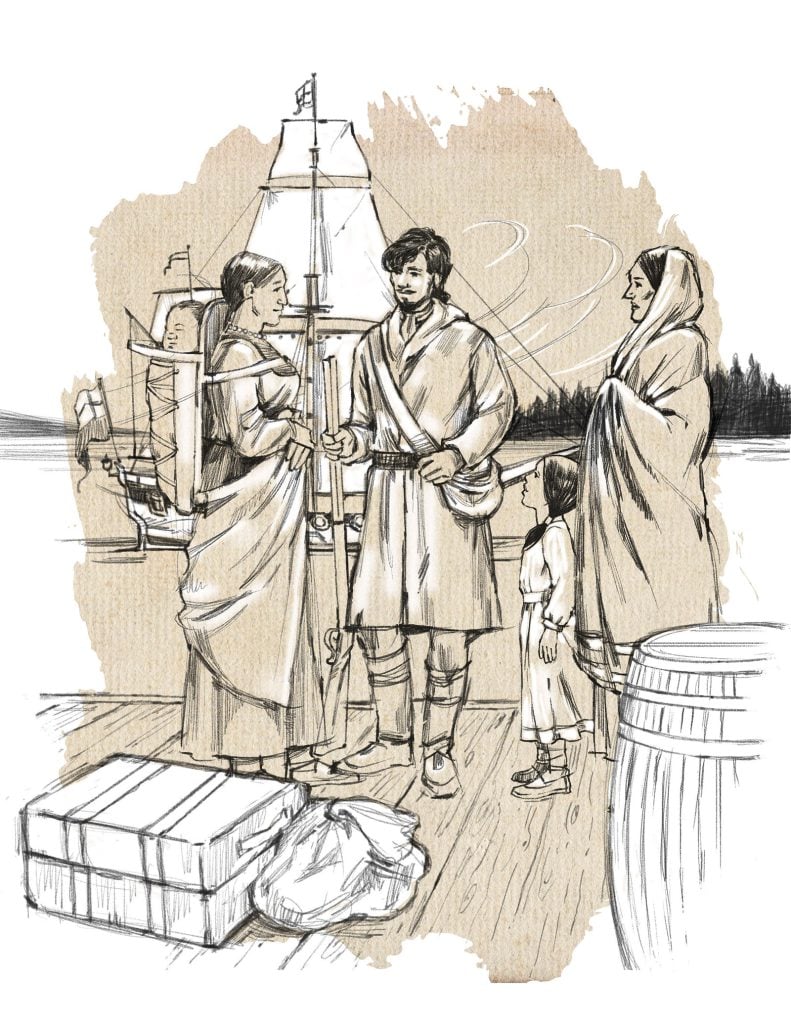
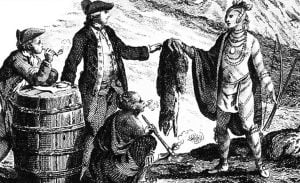
Other men demonstrated respect for their wives and families. Master canoeman William Flett ensured that upon his death, all his money went to “the sole use and benefit” of his “reputed wife, Saskatchewan.” Van Kirk relates the story of a Cree woman known as “Pawpitch, Daughter to the Captain of the Goose Hunters,” who fell ill in early 1771. Her husband, Humphrey Marten, recorded her passing at 2:50 a.m. on the morning of January 24. With her death, “my poor Child becomes Motherless,” Marten mourned.
These women, whose names rarely appear in the written record, and whose feelings about their marriages are impossible to know, were critical in the HBC’s development. Traders and officials relied on them to strengthen ties with male relatives who could provide furs and speak with trappers in Indigenous languages, not to mention cook, clean, care for their children and treat the furs they received.
Still, their labour was rarely rewarded by officials, whose attitudes toward Indigenous women became clear when their husband retired from the company or died. Until the early 19th century and the founding of Manitoba’s Red River Colony, HBC policy banned its contract employees, called “servants,” from settling in Rupert’s Land after they stopped working for the company. As a result, most men returned to Britain. But the company also banned employees from taking Indigenous wives or children with them.
Officials adopted this policy in the wake of the tragic story of Chief Factor Robert Pilgrim and his Cree wife, Thu-a-Higon, who retired to London in 1750 with their son. Soon after their return, Pilgrim died. In his will, he stipulated that his son should stay in England, while Thu-a-Higon was to return to her family in Churchill. While Thu-a-Higon likely agonized over the forced separation from her son, HBC officials agonized over the cost of sending her back and caring for the child. Hoping to prevent the situation from arising again, the company banned Indigenous men, women and children from travelling to Britain aboard HBC ships, “without Our Express order in Writing for so doing.” The policy sent a clear message: the HBC valued Indigenous Peoples in Rupert’s Land but considered them a hindrance any place else.
Attitudes toward Indigenous Peoples grew more disdainful by the mid-1800s, as HBC officials became more comfortable in the region and relied less on Indigenous knowledge. In 1822, Simpson wrote that Indigenous Peoples “must be ruled with a rod of iron, to bring and to keep them in a proper state of subordination.” Although he fathered children with Indigenous women, he eschewed marriage in the custom of the country and married his British-born cousin, Frances, in 1830. Simpson’s treatment of Indigenous women and Frances’s arrival to the colony marked the beginning of the end of marriage in the custom of the country. Taking a cue from their governor, other HBC men started marrying English and Scottish women. As Van Kirk notes, the arrival of white women stratified fur trade society and ushered in disrepute of the very Indigenous customs HBC employees had depended on for so long.
***
Back in London, the fur trade was making some men — and a few women who held shares in the company — rich. From 1738 through 1748, company imports to England from Rupert’s Land totalled more than £270,000. That’s more than £31 million in today’s currency. As historian David Chan Smith has calculated, from 1730 through 1750 this translated into more than one million beaver pelts.
English officials, Scottish traders, European consumers, Métis trappers, Ojibwe women and others from the Anishinaabeg Confederacy were just some of the people in the HBC’s fur trade, the products of which appeared on British soldiers’ belts in India, industrial machines in Liverpool and furniture in Manhattan. They were also the people who made an indelible mark on Rupert’s Land. Still, the fact that their story, and the story of the HBC, became a part of Canada wasn’t predetermined. Things could have gone differently. And some Americans were hoping they would.
By the mid-1800s, profits from the fur trade had dropped. The settler population of Canada and the United States was growing. Industrialization was spreading. The future was not in fur but in real estate, agriculture, railroads and oil and gas.
Meanwhile in Britain, public opinion was turning against the HBC. According to The Times, the company was “the last great monopoly which the improvidence and reckless favouritism of Charles II inflicted upon the commercial world.” Many Brits were eager to break down the HBC’s monopoly and open the region to settlement. Then in 1867, Nova Scotia, New Brunswick, Ontario and Quebec confederated, creating the Dominion of Canada. Under the leadership of Prime Minister John A. Macdonald, the government aimed to bring Western Canada into its fold and colonize the region. But Macdonald faced persistent and sustained resistance to this plan from Indigenous nations. And there was another challenge coming from the south.
From as early as the American Revolution, the British — and later Canadian — governments feared American encroachment. Alarm grew after the U.S. secured major territorial gains in the U.S.-Mexican War of the 1840s and purchased Alaska the year Canada confederated. Many Canadians felt entitled to the western territories, believing them to be an extension of the country’s eastern provinces. As George Brown, The Globe’s editor, wrote, Rupert’s Land was “the vast and fertile territory which is our birthright — and which no power on earth can prevent us occupying.”
While Brown and Macdonald saw the Americans as their foe, they shared a similar goal with them, as politicians such as Minnesota Senator Alexander Ramsey saw a future for their republic in Rupert’s Land. Ramsey had a history of working toward the colonization of Indigenous lands and had called for the “extermination” of local Sioux. By 1868, he was no less eager to secure Indigenous territories for American settlers, and presented a resolution to the Senate calling for the Committee on Foreign Relations to annex Rupert’s Land.
Ramsey hoped to make a deal the HBC (and U.S. Congress) couldn’t refuse. He proposed paying the company $6 million for its land claims and using that land to construct a Pacific railway and create three U.S. territories. The offer was a good deal for HBC shareholders, but it was $4 million less than what James Wickes Taylor, the U.S. Treasury’s special agent for the northwest, had proposed years earlier. It also came on the heels of added pressure from Macdonald, who had dispatched George-Étienne Cartier and William McDougall to London to discuss purchasing Rupert’s Land for Canada. In 1868, the Rupert’s Land Act was passed — an agreement to transfer the region from the HBC to Canada.
All this meant that although Ramsey’s plan was presented to the Senate, it never went anywhere. American authorities understood that the best policy was to respect earlier agreements on the U.S.-Canada border. But if shareholders were excited by the prospect of a seven-figure deal for their landholdings, they were less enthusiastic about the proposed deal with Canada. They knew they were sitting on valuable land and the brand-new Canadian government was broke. If there was any buyer who could pay a good price, it was the United States.
But the British and Canadian governments were eager to make the sale happen and keep the territory within the empire. So, the British Colonial Office pushed shareholders to accept £300,000 for the land, which the British government loaned Canada. This was a far cry from the millions Ramsey had proposed, but the British and Canadian governments sweetened the pot by promising the company title to some 10 million acres of their choosing.
The deal angered many Indigenous nations, who resisted the HBC’s transfer of their lands to a colonial power who wanted them to relinquish their claims and enter into confusing, often non-consensual treaties. At the acrimonious 1874 ceremony of the signing of Treaty 4, for instance, which covered large parts of southern Saskatchewan, Chief Paskwa of the Pasqua is reported to have said to an HBC official, “You told me you had sold the land for so much money — £300,000. We want that money.” Likewise, in an 1885 petition to U.S. President Grover Cleveland, Métis leader Louis Riel pointed out that the HBC had no right to sell the lands because it did not own them. These leaders identified a vicious irony of both the 1670 charter that created Rupert’s Land and the British legislation that transferred it to Canada. Just as Charles II had ruled on the creation of Rupert’s Land some 200 years earlier, a small group of mostly British men decided its future.